

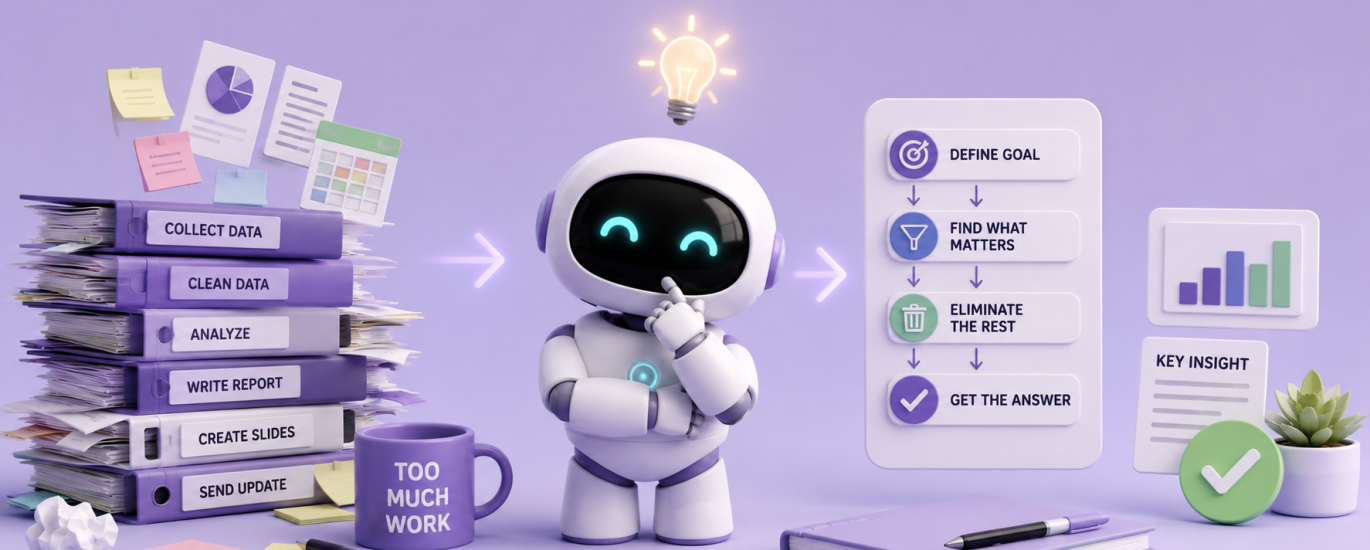
There’s a specific kind of productivity bottleneck where AI actually shines.
It usually starts with that familiar feeling: “I really don’t want to do this.”
You’re facing a report to write, a spreadsheet to clean, twenty customer reviews to analyze, or a 60-page document to plow through. The knee-jerk reaction is:
“How can AI help me get this done faster?”
Fair question. But there’s a much better one:
“Do I even need to do it this way in the first place?”
Automating the Wrong Part of the Job
Most of us call on AI only after we’ve already locked ourselves into a specific workflow.
The old playbook goes: read 50 reviews → categorize them → tally complaints → write a summary. Then we ask AI to categorize those reviews faster.
Great. But why are you still going through all the other steps? Feed it the reviews and try a different angle:
“My goal is to pinpoint the top three reasons customers are unhappy. What’s the fastest, most reliable way to get that answer from this data? Don’t stick to my current process unless it’s strictly necessary.”
This changes everything. You’re no longer asking a tool to speed up your assembly line—you’re asking it to design a new one centered on the actual outcome.
Start with the Outcome, Not the Steps
Say your manager asks for a competitor analysis. The default approach looks like this:
- Check out five competitors and browse their sites
- Read reviews
- Build a comparison sheet
- Write a memo and draft slides
A mountain of work. But what does your manager actually need? Probably just an answer to: Which competitor poses the biggest threat, and why?
Once you clarify that, the task shifts. Instead of a generic “Help me build a competitor analysis”, try:
“The final decision I need to make is [X]. Before I do any work, tell me the minimum information required to make that call confidently. Then map out the shortest route to get it.”
That’s how AI trims away whole steps instead of just polishing them.
Four Questions Before You Even Start
Before diving into any tedious task, run it past AI with these four questions:
- What is the actual outcome I need here?
- Which parts of this process are genuinely necessary to reach it?
- What can be dropped, merged, or automated?
- What’s the shortest reliable path to that outcome?
That word—reliable—is key. The goal isn’t to cut corners and deliver sloppy work; it’s realizing that a three-hour process might only require 40 minutes of actual effort.
Example: The Weekly Report Nobody Reads
Every Friday, you spend two hours on a status report. You pull numbers from four places, plug them into Excel, build charts, write commentary, export a PDF, and email it to eight people.
AI can easily help you write that commentary faster and save 20 minutes. But there’s a much more valuable question to ask:
What do those eight people actually care about in this report?
If the answer is three metrics, one chart, and knowing whether anything is on fire, the solution isn’t “make the report faster.” The solution is to stop making 80% of the report and send an automated one-page update instead.
Two hours turns into ten minutes. That isn’t AI doing your job faster—that’s AI showing you that half the job was pointless to begin with.
Speeding up unnecessary work doesn’t make it necessary. It just lets you waste time more efficiently.
Before asking AI to do something faster, ask it to challenge the task itself. The best prompt usually isn’t “Do this for me”, but: “Tell me why I’m doing this at all.”