

We have a productivity problem nobody warned us about.
We finally have access to almost everything humans have ever written…
…and apparently decided the logical response was to try to read all of it.
Newsletters. Reports. PDFs. Research papers. Slack threads. Saved articles. That fascinating 47-page report someone sent you with the words “Thought you might find this interesting.”
Thank you, Steve.
There goes Tuesday.
AI gives us a much better option.
Most people already use AI to summarize things after they’ve decided to read them.
But there’s an even more useful approach:
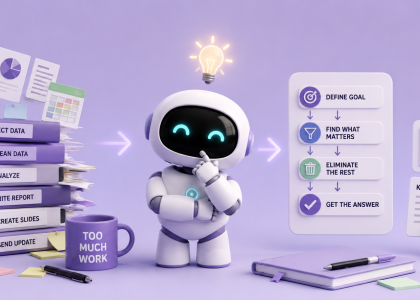
Let AI decide what’s worth your attention before you spend time on it.
Don’t Summarize. Filter.
Imagine you have ten articles about a topic you’re researching.
The obvious AI workflow is:
Open article #1.
Summarize it.
Open article #2.
Summarize it.
Repeat until you’ve created ten summaries that you now also have to read.
Congratulations.
You’ve automated reading by creating… more reading.
Instead, give AI all ten sources and explain what you’re actually trying to find out.
Then ask:
“Review these sources based on my goal. Rank them from most to least useful. For each one, tell me what unique information it contains, whether it repeats information found elsewhere, and whether I should read it in full, skim a specific section, or skip it.”
Now AI isn’t your summarizer.
It’s your editor.
Give It a Job, Not Just Documents
This works much better when AI knows why you’re researching something.
Let’s say you’re preparing a presentation about whether your company should introduce a four-day workweek.
Don’t simply upload a pile of reports and say:
“Summarize these.”
Tell AI:
“I’m preparing a 10-minute presentation for management about whether we should test a four-day workweek. I need reliable evidence about productivity, employee retention, costs, and potential disadvantages. Review these sources and tell me which are most relevant to those questions.”
Suddenly, a 60-page report might become:
Read pages 18–24. Ignore the rest.
An article you thought looked important might become:
Skip. It repeats the same statistics as Source 2 but provides no original research.
And another might get:
Read in full. This is the only source that discusses implementation costs.
That’s much more useful than ten generic summaries.
Use the Three-Level Rule
You can make the process ridiculously simple by asking AI to put everything into three buckets:
READ — important enough to deserve your full attention.
SKIM — useful, but only certain sections matter.
SKIP — repetitive, irrelevant, weakly sourced, or simply not useful for your goal.
For anything marked SKIM, ask AI to tell you exactly which section deserves attention and why.
Now instead of reading 200 pages, you might read 35.
And unlike blindly relying on a summary, you’re still reading the most important original material yourself.
But Don’t Let AI Decide What’s True
There’s an important distinction here.
We’re asking AI to help decide what deserves our attention, not to become the final authority on the subject.
If you’re making an important business, financial, scientific, legal, or medical decision, you still need to check the original sources.
AI can miss context.
It can misunderstand a document.
And yes, it can confidently tell you something completely wrong while sounding like the smartest person in the meeting.
Use it as a filter, not a fact machine.
The Real Productivity Hack
We’re obsessed with using AI to do things faster.
Write faster.
Research faster.
Summarize faster.
Reply faster.
But sometimes the biggest productivity gain comes from something much simpler:
Doing less.
If AI can help you discover that eight of the twelve things sitting in your reading queue aren’t actually worth your time, that’s potentially more valuable than summarizing all twelve.
Because the fastest way to read a 40-page report…
…is still not reading the 35 pages you don’t need.