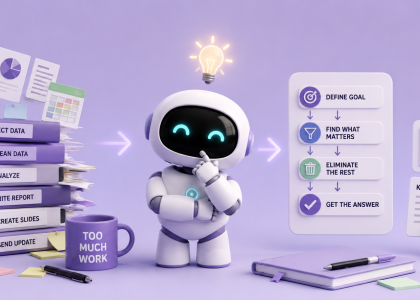

One of the most common ways people waste time isn’t by being lazy.
It’s by becoming incredibly efficient at the wrong thing.
Think about it.
Have you ever spent hours tweaking a presentation, improving a workflow, researching a purchase, or perfecting a piece of content—only to realize later that none of it really moved the needle?
We’ve all done it.
The problem isn’t effort.
The problem is direction.
And that’s where a surprisingly simple AI prompt can help:
“Am I optimizing for the wrong thing?”
At first glance, it feels almost too simple.
But it forces AI to do something different. Instead of helping you execute your plan better, it challenges whether your plan is worth executing in the first place.
The Productivity Trap
Imagine you’re trying to become more productive.
Most people ask:
“How can I get more done?”
AI will happily suggest task managers, time blocking, automation tools, and productivity systems.
But what if the real question is:
“Do I actually need to do all these things?”
Suddenly the conversation changes.
Instead of optimizing your workload, you start questioning it.
And that’s often where the biggest gains come from.
Example 1: Growing a Newsletter
Let’s say your goal is to get more subscribers.
You ask AI:
“How can I grow my newsletter faster?”
Reasonable question.
But try this instead:
“Am I optimizing for the wrong thing?”
AI might point out that subscriber count isn’t actually the goal.
Maybe what you really want is:
- More engaged readers
- More replies
- More customers
- More partnerships
Growing from 5,000 to 10,000 subscribers sounds great.
But if engagement drops by half, did you actually win?
Example 2: Social Media
A lot of creators spend enormous amounts of time chasing followers.
Ask AI:
“Am I optimizing for the wrong thing?”
You may discover that:
- Followers aren’t the goal.
- Reach isn’t the goal.
- Likes aren’t the goal.
The real goal might be:
- Leads
- Clients
- Email subscribers
- Sales
One loyal customer is often worth more than 1,000 likes.
Example 3: Learning AI
This one hits close to home.
Many people spend months learning:
- Every new model
- Every new tool
- Every new framework
- Every new acronym
The result?
A lot of learning.
Not much building.
Try asking:
“Am I optimizing for AI knowledge when I should be optimizing for AI usage?”
That’s a very different question.
Knowing about AI and benefiting from AI are not the same thing.
Example 4: Business Processes
This is one of our favorites.
A company spends weeks trying to make a process 20% faster.
AI reviews the workflow and responds:
“Why does this process exist at all?”
Ouch.
But sometimes that’s exactly the right question.
The biggest efficiency gain isn’t improving a process.
It’s eliminating it.
Example 5: Content Creation
Many creators focus on producing more content.
AI might suggest:
- Better scheduling
- Better workflows
- Better automation
But ask:
“Am I optimizing for the wrong thing?”
And you may discover the problem isn’t output.
It’s distribution.
Or positioning.
Or audience fit.
Publishing twice as much content doesn’t help if nobody sees it.
Why This Prompt Works
Most prompts assume your goal is correct.
This one doesn’t.
Instead of helping you run faster, it asks whether you’re running in the right direction.
And that’s surprisingly rare.
AI is usually very good at helping us do things.
It’s less common to ask whether those things are actually worth doing.
Try These Variations
The next time you’re stuck, experiment with prompts like:
“Am I optimizing for the wrong thing?”
“What’s the real goal here?”
“If I achieved this perfectly, would it actually solve my problem?”
“What metric am I focusing on that may not matter?”
“What’s the real bottleneck?”
“What would an experienced consultant tell me to stop focusing on?”
These questions often produce more valuable insights than asking for another productivity hack.
Final Thought
Most people assume success comes from doing more.
Sometimes it does.
But sometimes success comes from realizing you’ve been measuring the wrong thing all along.
Because improving the wrong thing by 100% is still less valuable than improving the right thing by 10%.
Before you ask AI how to work harder, faster, or smarter, try asking one question:
“Am I optimizing for the wrong thing?”
The answer might change what you’re working on altogether.