For the past two years, we’ve all been hearing the same prediction.
“AI is coming for your job.”
And honestly? Looking at what today’s AI can do, it’s easy to understand why. It writes emails, creates presentations, builds websites, designs logos, summarizes meetings, and even writes code. Every new model seems capable of doing something that felt impossible just six months earlier.
So… are we all about to become obsolete?
Maybe not.
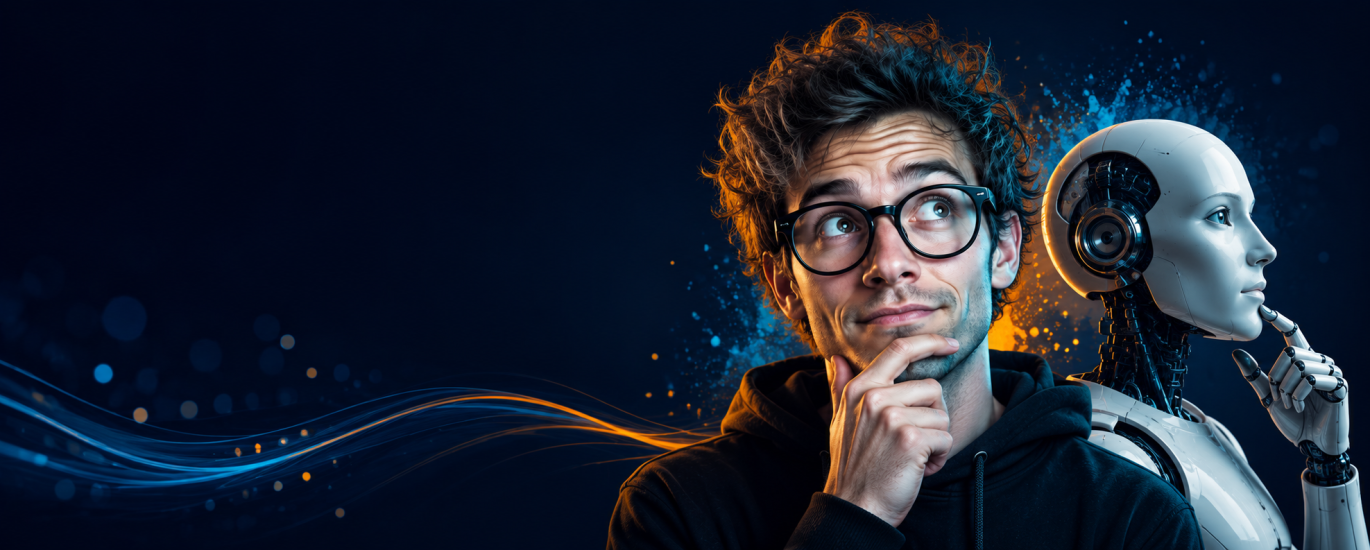
After spending countless hours working with AI every single day, I’ve noticed something interesting. AI isn’t replacing the people who stand out. It’s replacing work that looks the same.
Welcome to the Age of Average
Take five minutes and scroll through LinkedIn.
You’ll probably see a dozen posts that all sound strangely familiar.
Someone starts with a dramatic hook.
“Nobody is talking about this…”
Then comes a personal story that may or may not have happened.
Three bullet points.
A motivational conclusion.
A rocket emoji.
By the fifth post, you’re not even sure whether you’re reading different people or the same chatbot with multiple accounts.
The funny part?
None of the content is actually bad.
It’s well written. Grammatically correct. Structured. Clear.
It’s just… forgettable.
And that’s becoming one of AI’s biggest side effects. When everyone uses the same tools in the same way, everything slowly starts sounding the same.
AI Doesn’t Think. It Predicts.
This is something many people still misunderstand.
AI doesn’t wake up in the morning thinking, “I have a brilliant idea.”
It predicts what word is most likely to come next based on billions of examples it has already seen.
That’s exactly why it’s so good at writing proposals, summarizing documents, translating text, or explaining complicated topics.
Those tasks have patterns.
Lots of them.
But the things we remember rarely follow a pattern.
Nobody remembers the safest presentation at the conference.
Nobody shares the article that sounds exactly like every other article.
We remember the speaker who told an unexpected story.
The designer who broke the rules.
The entrepreneur who admitted their biggest failure instead of pretending everything was perfect.
Originality almost always starts where the pattern ends.
Being Weird Is Suddenly Good Business
Here’s something I never expected to write.
Being a little weird has become a competitive advantage.
Not weird for the sake of being weird.
But unapologetically yourself.
Maybe you’re the consultant who explains strategy using football.
The biology teacher who compares DNA to IKEA instructions.
The founder who isn’t afraid to joke about failed launches.
Or the marketer who publicly disagrees with every new AI trend instead of praising all of them.
Those little things make people remember you.
Because AI can imitate a style.
It struggles to imitate a personality.
Your Life Is Proprietary Data
Here’s something no frontier model has access to.
The day you completely messed up an important presentation.
The client who taught you your biggest business lesson.
The side project that failed but accidentally led to your best idea.
The hobby you’ve had since you were twelve that somehow influences your work today.
Those experiences aren’t on the internet.
They’re not in a training dataset.
They’re yours.
Ironically, while everyone is trying to learn how to sound more like AI…
The people winning are often the ones who sound the least like it.
The New Premium Feature Is You
A few years ago, having access to AI was an advantage.
Today, almost everyone has access to the same models.
Tomorrow, almost everyone will have access to even better ones.
So what becomes scarce?
Taste.
Judgment.
Humor.
Curiosity.
Original experiences.
In other words—the things AI can’t download from the internet.
Think about your favorite creators.
You probably don’t follow them because every sentence is perfect.
You follow them because they’re recognizable after three lines.
That’s personality.
And in an AI-first world, personality is becoming a premium feature.
So… Should You Use AI?
Absolutely.
Use it to brainstorm.
Research.
Rewrite.
Challenge your assumptions.
Find blind spots.
Make your work faster.
But don’t outsource the one thing that makes people choose you instead of someone else.
Your opinions.
Your stories.
Your perspective.
Those aren’t bugs.
They’re your competitive advantage.
Final Thought
The future probably won’t belong to the people who use the most AI.
It will belong to the people who use AI without becoming AI.
Because when everyone has access to the same tools, being different becomes more valuable than being faster.
And that might be the most human competitive advantage of all.