
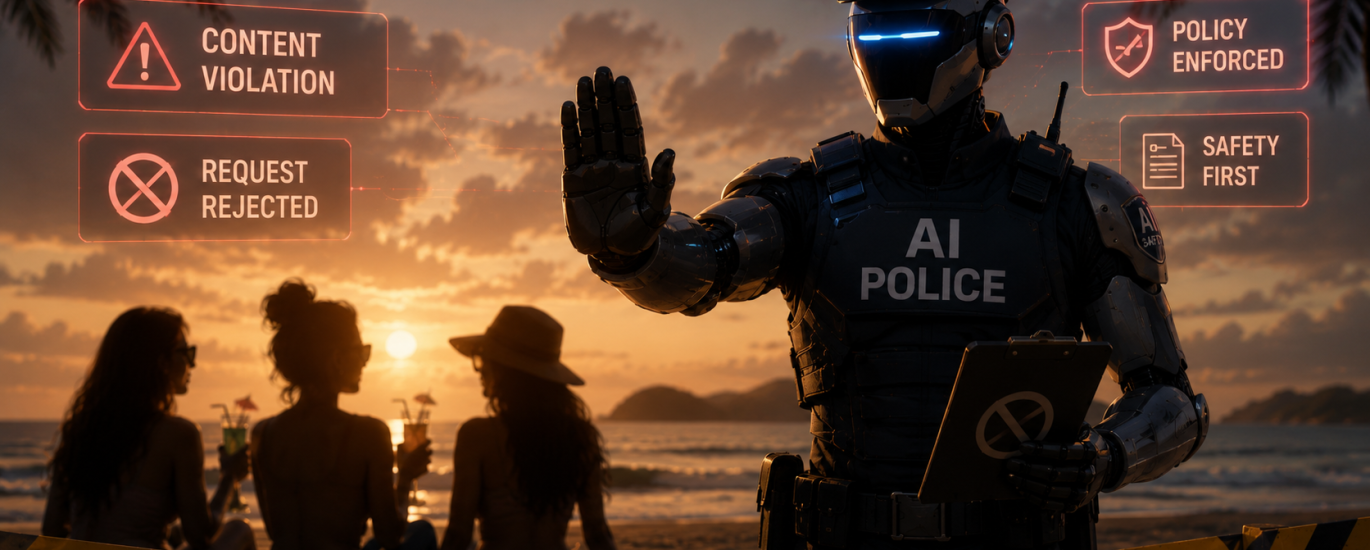
A few days ago, I tried to generate a simple image.
Three moms relaxing on a beach, enjoying cocktails.
Rejected.
Apparently, that crossed a line.
Adding two words solved the problem:
“non-alcoholic cocktails.”
Suddenly, everything was fine.
The image generated without issue.
Now, let’s pause for a second.
We’re talking about silhouettes on a beach.
Not minors.
Not dangerous behavior.
Not instructions for making alcohol.
Not anything remotely controversial.
Just people holding drinks.
And yet, the AI treated those two prompts very differently.
That’s when I started wondering:
Is AI becoming too careful for its own good?
The Problem Isn’t Safety
Let’s be clear.
AI companies should absolutely have safety rules.
Nobody wants AI helping people commit crimes, create scams, generate harmful content, or bypass laws.
That’s not the issue.
The issue is when safety systems start losing the ability to distinguish between genuinely risky content and perfectly normal requests.
Because at some point, the question becomes:
Is the model protecting users, or is it protecting itself from making a mistake?
The Rise of the False Positive
In technology, this is called a false positive.
A system flags something as dangerous even though it isn’t.
Spam filters do it.
Security software does it.
AI does it too.
The challenge is that modern AI systems aren’t just trying to answer questions.
They’re also constantly evaluating whether they should answer them.
And sometimes those filters become overly cautious.
The result?
Normal requests get caught in rules that were designed for completely different situations.
The Context Problem
The cocktail example is interesting because context matters.
A lot.
Most humans would instantly understand that:
- three adults on a beach
- silhouettes
- a holiday scene
isn’t problematic.
In fact, most people probably wouldn’t even think about the alcohol question at all.
The AI, however, appears to see the word “cocktail” and trigger additional caution.
Technically, that’s understandable.
Practically, it’s frustrating.
Because intelligence isn’t just about recognizing words.
It’s about understanding context.
And if an AI can write code, summarize research papers, and explain quantum physics, users naturally expect it to understand the difference between a beach illustration and something genuinely harmful.
You’re Not the Only One
Spend enough time on Reddit, AI forums, or social media and you’ll find similar stories everywhere.
People report:
- image prompts being rejected for strange reasons
- harmless historical content getting blocked
- educational requests triggering warnings
- repeated prompt rewrites just to get basic results
The details vary.
The pattern is familiar.
Many users feel they increasingly need to learn how to phrase requests for the AI rather than simply telling it what they want.
And that’s backwards.
The technology is supposed to adapt to humans.
Not the other way around.
Why This Is Happening
The answer is actually pretty simple.
AI companies are under enormous pressure.
Governments are watching.
Regulators are watching.
Journalists are watching.
Every problematic output becomes a headline.
Almost nobody writes an article when the system works correctly.
As a result, the incentives are obvious.
If a company must choose between:
- occasionally blocking harmless content
- occasionally allowing problematic content
many will choose the first option.
From a risk-management perspective, that’s understandable.
From a user experience perspective, it can be incredibly annoying.
The Bigger Question
What’s interesting is that this problem may actually become more visible as AI improves.
Because expectations rise.
Nobody expects a basic calculator to understand nuance.
People absolutely expect advanced AI systems to understand nuance.
The smarter these systems appear, the more frustrating these edge cases become.
Not because they’re dangerous.
Because they feel irrational.
Final Thought
The goal of AI safety should not be to block everything that might possibly be interpreted as risky.
The goal should be understanding context well enough to tell the difference.
That’s the real challenge.
Not whether a cocktail is alcoholic.
Not whether a beach scene is acceptable.
But whether AI can understand the situation well enough to know why those questions shouldn’t matter in the first place.
Because if users need to spend more time rewriting prompts than describing what they actually want, the system isn’t becoming more intelligent.
It’s becoming harder to use.