
When people talk about AI, they usually talk about models.
The latest chatbot.
The newest image generator.
The next AI agent.
But behind every AI breakthrough is something far less glamorous:
A data center.
And as AI becomes more powerful, data centers are becoming one of the biggest challenges in technology.
Not because they’re running out of space.
Because they’re running out of cooling.
The Hidden Cost of AI
Every AI prompt, image generation, video creation, and agent workflow requires computing power.
Computing power creates heat.
Lots of heat.
In fact, cooling has become one of the largest expenses associated with running modern AI infrastructure. The more capable AI models become, the more energy they consume—and the more heat they generate.
For years, companies tried to solve this problem by building bigger cooling systems.
Then some engineers asked a different question.
What if we stopped fighting the ocean and started using it?
The Ocean as a Giant Cooling System
Instead of building larger air-conditioning systems, China is experimenting with something that sounds almost absurd at first:
Putting AI servers underwater.
Literally.
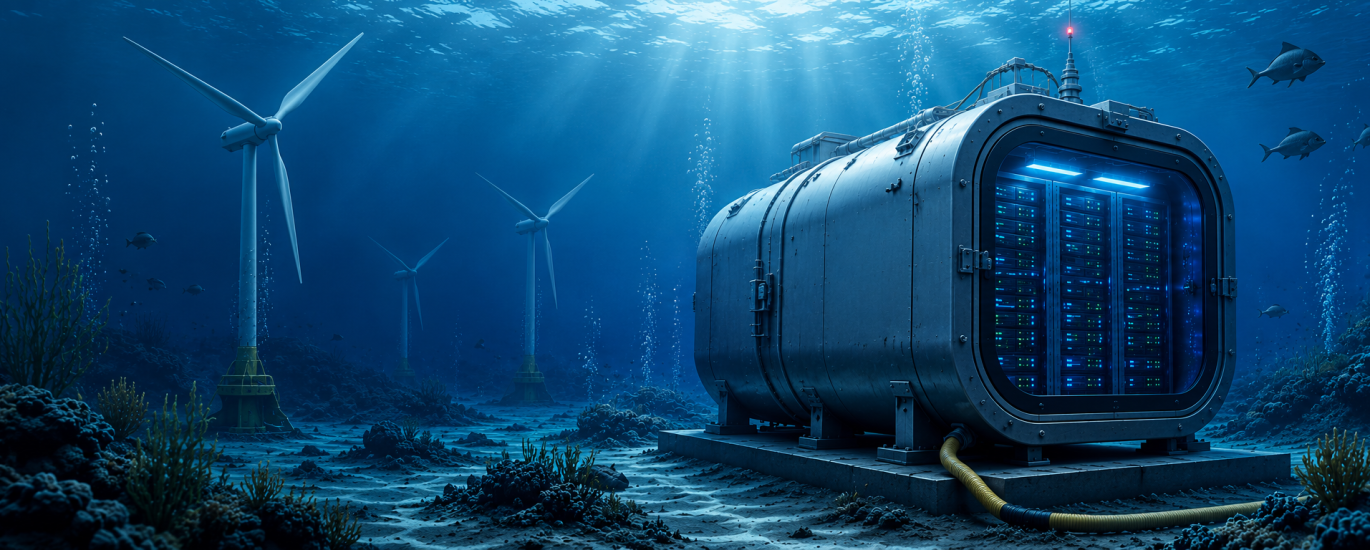
One of the most interesting examples is a new underwater AI data center located about 10 kilometers off the coast of Shanghai. The facility houses nearly 2,000 servers, supports AI workloads, cloud computing, and big data applications, and is powered entirely by offshore wind energy.
The servers sit inside sealed, pressure-resistant modules beneath the ocean.
And instead of relying on traditional cooling systems, they use the surrounding seawater as a natural heat sink.
No giant cooling towers.
No massive air-conditioning systems.
Just the ocean.
Why This Matters
Cooling isn’t a minor problem.
Globally, data centers consume enormous amounts of electricity, and a significant portion of that energy goes toward keeping servers from overheating.
The Shanghai project reportedly achieves a Power Usage Effectiveness (PUE) of around 1.15.
Without getting too technical, lower is better.
Many conventional data centers operate at significantly higher numbers because they need far more energy for cooling.
The underwater approach also reduces the need for freshwater and can cut cooling-related energy consumption by more than 20%.
That’s a meaningful improvement when you’re running thousands of servers around the clock.
The Real Lesson Isn’t About Servers
What makes this story fascinating isn’t the engineering.
It’s the thinking.
Most attempts at optimization focus on improving an existing process.
A faster workflow.
A better tool.
A more efficient system.
The engineers behind these underwater data centers did something different.
They challenged the assumption.
Instead of asking:
How can we build a better cooling system?
They asked:
Why are we cooling servers this way in the first place?
That’s a completely different question.
And it led to a completely different solution.
The Same Principle Applies Everywhere
This isn’t just a lesson for infrastructure engineers.
It’s a lesson for all of us.
When we get stuck, our instinct is usually to optimize.
Write faster.
Work harder.
Create more.
Automate another step.
But sometimes the biggest gains come from questioning the problem itself.
Imagine asking:
- Why am I attending this meeting?
- Why does this task exist?
- Why am I doing this manually?
- Why am I measuring this metric?
- Why is this process designed this way?
Those questions often unlock bigger improvements than any productivity hack.
A Future Beneath the Waves
China isn’t stopping with a single underwater facility.
The country is already developing larger underwater data center projects, including installations off the coast of Hainan, where long-term plans call for dozens of underwater data modules.
Whether underwater data centers become the norm remains to be seen.
There are still challenges involving maintenance, corrosion, storms, and physical access to the hardware.
But that’s almost beside the point.
The important thing is that someone looked at a growing problem and stopped asking how to improve the existing solution.
They asked whether there was a completely different solution altogether.
Final Thought
Most people think efficiency means doing the same thing faster.
The best examples of efficiency usually involve doing something differently.
China’s underwater AI servers are a perfect example.
The engineers didn’t build a slightly better cooling system.
They found a way to use the ocean itself.
And that’s often where the biggest breakthroughs come from.
Not better answers.
Better questions.