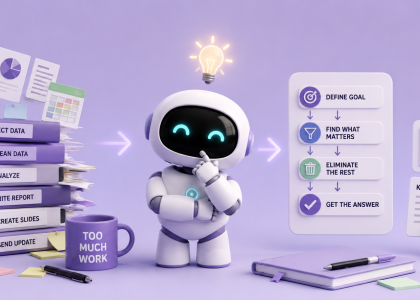

At some point, AI productivity started to feel like Pokémon: Gotta catch ‘em all. The cycle is predictable. A new tool launches, Twitter explodes, and a self-proclaimed guru calls it “game-changing.” You open 17 tabs, create six new accounts, forget five of the passwords, and by the end of the day, you’re back to using the same two tools you started with.
This is the hidden productivity trap of the AI era. We tell ourselves that the “perfect stack” is just one more sign-up away. But the uncomfortable truth is that too many options lead to less output. The people seeing massive results aren’t the ones testing 100 tools a week; they are the ones who picked a handful and mastered them.
What is the 80/20 AI Stack?
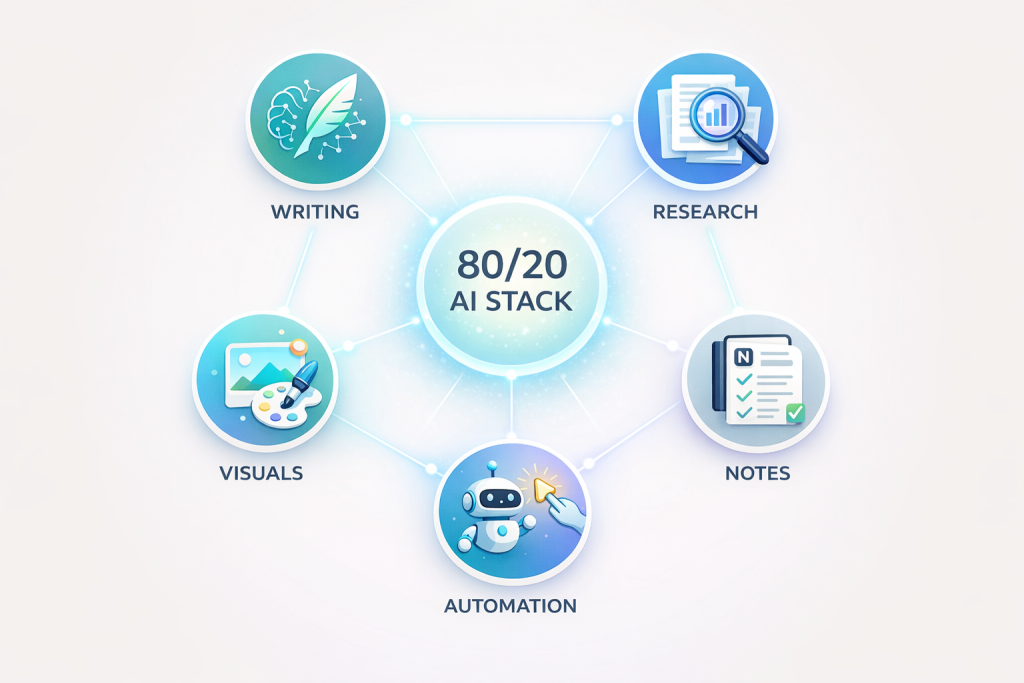
The 80/20 AI Stack is built on a simple premise: Identify the 20% of tools that deliver 80% of your results. Instead of chasing novelty, you build a compact toolkit that covers the core workflows you repeat every single week: Writing, Research, Organization, Visuals, and Automation.
When you narrow your focus, your daily tasks move faster. This isn’t because the tools are magical, but because context switching is expensive. Jumping between six different AI interfaces kills momentum, and momentum is productivity’s best friend.
A Practical 80/20 AI Stack (The Lean Setup)
Here is a streamlined setup that covers the vast majority of knowledge work without turning your browser into a “tool museum.”
- Thinking & Writing: ChatGPT
ChatGPT remains the cornerstone of the stack because of its versatility. It isn’t just a chatbot; it’s a cognitive partner. Whether you are brainstorming a project, restructuring a messy article, or simplifying a complex technical concept, it serves as the ultimate “first draft” engine.
- Why it stays: It supports almost every cognitive task in a single interface.
- Research Without the Noise: Perplexity
Traditional search engines force you to juggle a dozen tabs to find a single answer. Perplexity eliminates this friction by acting as a hybrid between a search engine and an explanation layer. It provides cited sources, summarizes long pages, and performs fact-checking in real-time.
- Why it stays: It provides clarity and citations, ending the “tab chaos” of traditional research.
- Notes & Organization: Notion AI
Productivity dies in a disorganized workspace. By using Notion AI, you keep your thinking and your data in the same place. It can turn messy meeting transcripts into actionable items or structure a week’s worth of scattered ideas into a coherent knowledge base.
- Why it stays: It ensures your “second brain” stays organized without manual effort.
- Visual Content: Canva Magic Studio
You don’t need to be a designer to produce professional visuals. Canva’s AI suite handles social media assets, presentations, and simple image editing with a few clicks. It bridges the gap between “no design skills” and “high-quality output.”
- Why it stays: It delivers fast results without the steep learning curve of complex design software.
- Everyday Micro-Automation: Copilot / Gemini
These are the “friction removers.” Integrated directly into your OS or browser, these tools handle the tiny, repetitive actions—drafting a quick email response, summarizing a PDF, or fixing a spreadsheet formula—that otherwise eat up your day.
- Why it stays: It’s always there, removing the barrier to entry for small, frequent tasks.
Why Less is More
We often equate “more tools” with “more productivity,” but in reality, a bloated stack creates decision fatigue and fragmented workflows. When you limit your toolkit, you develop:
- Familiarity: You know exactly how to prompt each tool for the best result.
- Speed: You stop wondering which tool to use and start doing the work.
- Consistency: Your output becomes repeatable and reliable.
Real productivity doesn’t come from discovering new tools; it comes from using your existing tools consistently.
The Simple Rule for Choosing Tools
If you’re tempted by a new launch, ask yourself: “Does this tool replace something I already do frequently?” If the answer is no, it’s likely a distraction. A good candidate for your stack is a tool that reduces friction or helps you start faster. If it requires a complex setup to solve a problem you don’t actually have, skip it.
Final Thought
The AI space moves at a breakneck pace—new features appear weekly and new hype appears hourly. But true productivity usually improves when complexity decreases.
You don’t need the biggest stack; you need the stack you actually use. The best AI workflow isn’t the one with the most logos—it’s the one that quietly helps you finish your work and reclaim your time.