
There is still something slightly ridiculous about Suno.
You type a description. Add some lyrics. Choose a style. Click a button.
And a few seconds later, there is a song.
Not a rough MIDI sketch or a robotic demo vocal. An actual produced track with instruments, arrangement, vocals, harmonies, and something resembling a finished mix.
The first few times you do it, it feels like magic.
But we recently had a chance to see what happens when you take Suno out of the “this is fun” category and ask it to do an actual professional job.
And that’s where things got interesting.
From Playground to Production Tool
Suno has changed enormously.
Its paid plans now offer newer models, advanced editing, audio uploads, stem separation, the ability to add vocals or instrumentals to existing tracks, commercial-use rights, and more control over generated music.
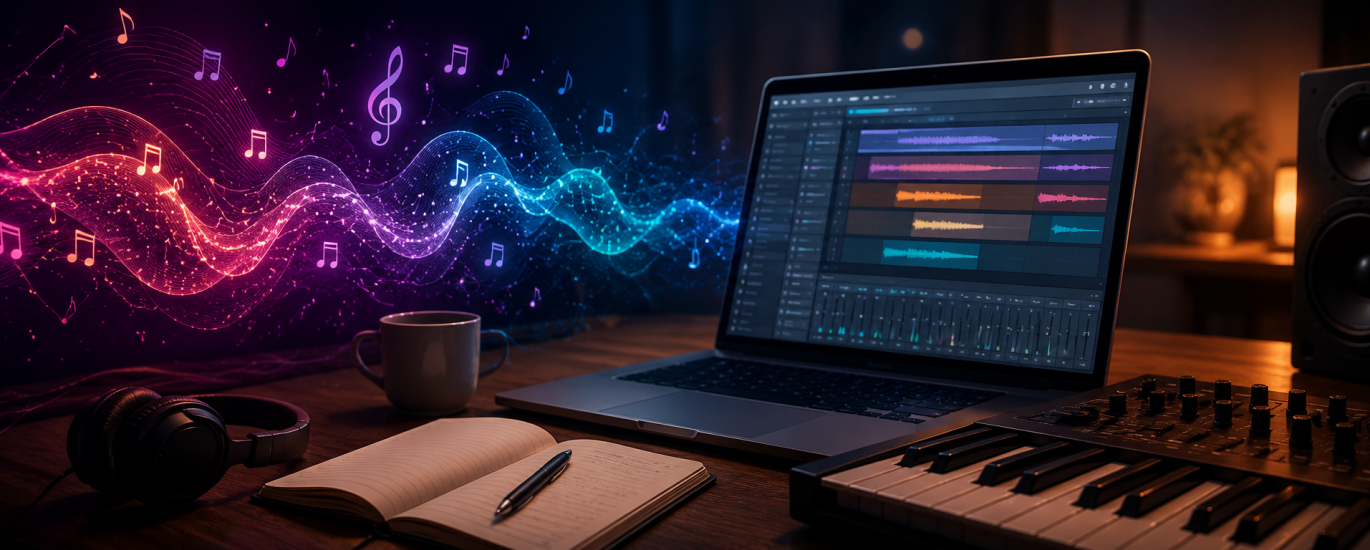
At the higher end, Suno Studio moves even closer to a traditional music-production environment, with a multitrack timeline, stems, tempo and pitch controls, and audio and MIDI export.
In other words, Suno clearly doesn’t want to remain the website where you ask AI to write a death-metal song about your accountant.
It wants to become a serious creative tool.
So we decided to treat it like one.
We Gave Suno a Real Job
One of our colleagues is a composer who was commissioned to create music for a professional children’s theatre production.
This time, instead of composing everything traditionally, he decided to experiment with the paid version of Suno as part of the process.
This wasn’t a joke song for someone’s birthday or background music for TikTok. There were actual requirements: specific lyrics, characters, moods and songs that needed to work within particular scenes.
And Suno turned out to be simultaneously astonishing and incredibly frustrating.
First: The Astonishing Part
The speed is absurd.
You describe the style, tempo, atmosphere, instrumentation and vocals you want, and within seconds you’re listening to something that sounds surprisingly close to a produced song.
Then you generate another.
And another.
Suddenly, in the time it might traditionally take to experiment with a few musical ideas, you have an entire folder of different arrangements.
That alone makes Suno an extraordinary idea-generation machine.
But what surprised us even more were the vocals.
The Vocals Are Seriously Impressive
Our songs were in Croatian, which made this a particularly interesting test.
Many AI voice tools that sound almost flawless in English suddenly struggle with Croatian. Stress goes to strange places, pronunciation becomes awkward, and you immediately hear that something isn’t quite right.
Suno surprised us.
The generated singers sounded remarkably natural, and the Croatian pronunciation was often excellent. The voices had expression, dynamics and character rather than sounding like synthetic text-to-speech layered over music.
When the right generation appeared, our reaction was essentially:
Wait. It made THAT in a few seconds?
And then came the problem.
The 90% Problem
Anyone who works with generative AI probably knows this feeling.
You ask an AI writing tool for something and receive a result that is 90% excellent.
With text, that’s easy. Delete the bad paragraph, rewrite it and move on.
Music doesn’t work like that.
We would generate a song and think:
This is it.
The melody works. The arrangement works. The chorus works. The singer sounds fantastic.
Except for one line.
Maybe the rhythm is slightly wrong. Maybe one word is stressed strangely. Maybe the ending needs to be shorter.
Suddenly that remaining 10% becomes the entire problem.
“Just Fix That Part” Isn’t Quite That Simple
Suno does now offer considerably more editing control. Paid users can replace sections, change lyrics, crop songs and regenerate selected parts, while Studio provides more detailed production controls.
But generative editing still isn’t the same as opening a document and changing a sentence.
When you regenerate a problematic section, you’re generating something new.
It might fix the thing you hated…
…while changing the thing you loved.
So you generate again.
Different result.
Again.
Different result.
Eventually, you realize you’re no longer editing the original song.
You’re auditioning its increasingly distant cousins.
Welcome to the Generation Loop
This was probably the biggest frustration.
You have something that’s almost perfect, so you generate another version hoping for the missing 10%.
It’s worse.
Again.
Great chorus. Wrong verse.
Again.
Wrong singer.
Again.
Why is there suddenly a saxophone?
Because generating another version takes seconds, generation itself starts becoming the editing process.
That’s incredibly powerful when you’re looking for ideas.
It’s considerably less efficient when you already know exactly what you want.
So Is Suno Actually Useful for Professional Music?
Our answer is:
Yes—but perhaps not in the way you initially expect.
Suno has developed far beyond a fun AI music generator. With better models, Studio, stems, MIDI export and increasingly sophisticated editing, it is becoming a genuine production tool.
But if you need precise artistic control, the strongest workflow may still involve a human musician.
Instead of:
Prompt → Finished Song
the more realistic workflow may be:
Prompt → Generate → Discover → Select → Rebuild → Finish
Use Suno to explore arrangements, melodies and musical directions you hadn’t considered. Generate multiple interpretations. Find the version where 90% works beautifully.
Then take what works and finish it yourself.
Maybe That’s the Point
We often ask:
Can AI replace the person who normally does this?
After working with Suno, that feels like the wrong question.
A better one might be:
Can AI give that person ideas they wouldn’t have reached as quickly on their own?
For a composer, Suno can produce dozens of musical directions in minutes. Some will be terrible. Some will be bizarre.
And occasionally one will make you stop and think:
That’s interesting. I wouldn’t have done that.
That’s where Suno becomes genuinely valuable—not necessarily as the composer and definitely not just as a toy, but as an extremely fast, occasionally brilliant, slightly uncontrollable creative partner.
For our children’s theatre production, the answer isn’t to press Generate until Suno magically delivers the perfect final song.
It’s to recognize when AI has given us the 90% worth keeping—and then sit down at an instrument and finish the last 10% ourselves.
Because Suno can generate a song in seconds.
Knowing exactly what the song needs to become is still the human part.