
You know what’s funny about productivity tools? They used to behave like toddlers.
“Look what I did!” “Look again!” “LOOK AGAIN BUT WITH A NOTIFICATION SOUND.”
Every new tool wanted your undivided attention, an onboarding marathon, and usually your email, password, and half your personal history just to sign up. We accepted this because the promise was always the same: This tool will save you time.
Ironically, managing productivity tools became its own category of work. Then AI changed the game—not by getting louder, but by getting quieter.
The Shift from Destination to Integration
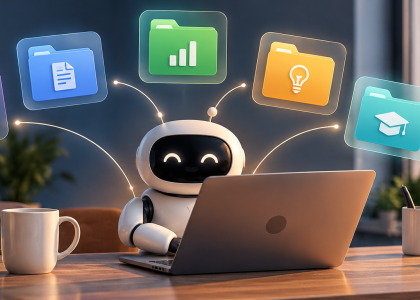
AI is moving away from being a separate platform you visit and toward becoming a built-in capability. We are entering the era of the Invisible Productivity Layer.
Instead of thinking, “I need an AI tool for this,” you find yourself thinking, “Oh nice, this app already does that.” It’s the moment when AI stops feeling like a separate entity and starts feeling like a natural extension of your own workflow.
AI is becoming:
- The autocomplete that actually understands your context.
- The summary that appears before the wall of text overwhelms you.
- The rewrite suggestion that saves a paragraph in seconds.
- The brainstorm partner that never says, “Let’s circle back.”
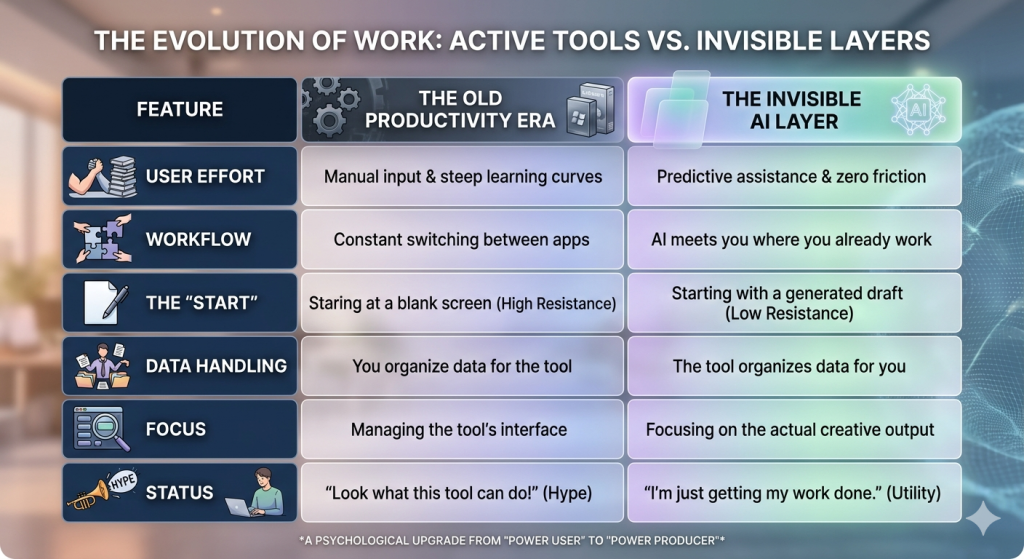
The Evolution of Work: Active Tools vs. Invisible Layers
The shift to invisible AI is best understood by looking at how our relationship with software has changed. We are moving from “Tools we manage” to “Capabilities that support us.”
Real-World “Invisible” Wins
We are no longer just “using AI”; we are experiencing upgraded versions of the tasks we already do.
- Writing & Thinking: You don’t “use AI”—you just turn messy notes into a structured outline in 30 seconds via Notion AI or Google Docs.
- Research: You don’t “do AI research”—you get a sourced answer from Perplexity or Copilot instead of opening 20 browser tabs.
- Meetings: You don’t “process audio”—Fireflies or Otter simply ensure you never have to write manual meeting notes again.
- Design: You don’t “prompt an engine”—you just expand an image or remove a background inside Canva or Adobe Firefly.
The Real Bottleneck: Resistance
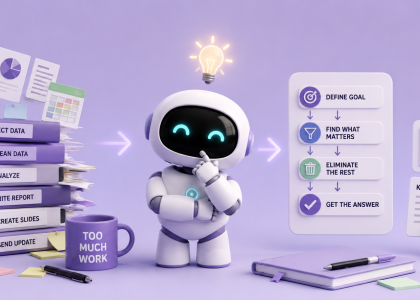
The biggest gain from AI isn’t dramatic automation; it’s the removal of friction.
Productivity isn’t just about saving minutes; it’s about reducing resistance. Resistance is that heavy feeling of staring at a blank page or procrastinating on a complex 40-page PDF. AI turns “I should start this” into “This is already started.”
When you remove the friction of the first draft or the dread of a long transcript, you aren’t just saving time—you’re preserving your mental energy for the work that actually requires a human touch.
Final Thought: The Beauty of the 🥱
The most transformative technologies eventually become boring. Electricity is boring. Wi-Fi is boring. Autocorrect is boring (until it fails).
AI is heading in the same direction. We are moving past the hype and into background utility. The real revolution isn’t about doing more things—it’s about removing just enough friction so that doing your work no longer feels like pushing a piano uphill.