Why using AI is no longer optional — it’s expected
There was a short period when using AI felt like a secret advantage.
People were quietly using ChatGPT to:
- write emails faster
- summarize documents
- prepare presentations
- generate ideas
It almost felt like cheating.
Like you found a shortcut others didn’t know about yet.
That phase is over.
Today, AI is no longer a hidden productivity hack.
It is becoming a baseline expectation.
The Shift That Already Happened
For a while, using AI meant you could produce more work in less time.
Now, many companies assume you already do.
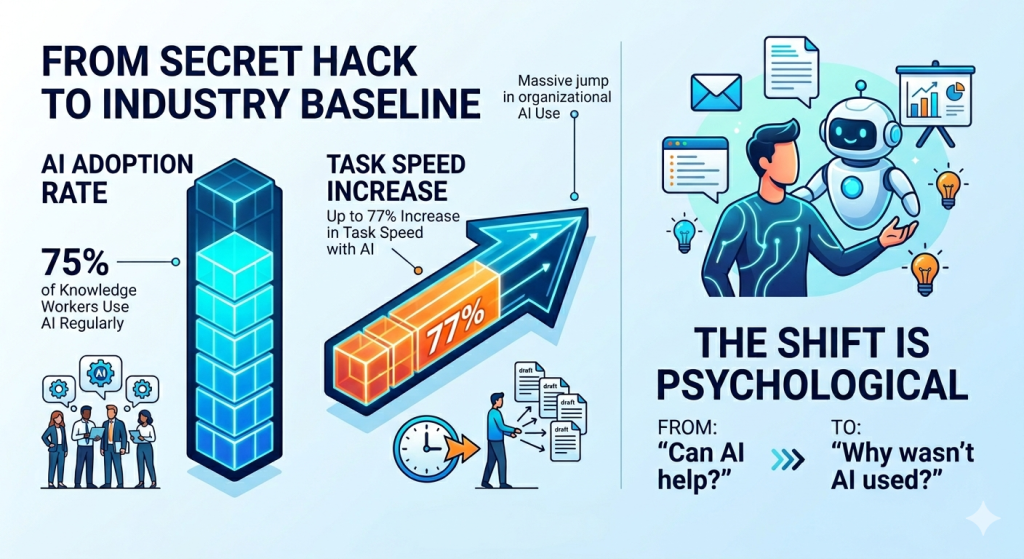
Research shows that 75% of knowledge workers already use AI tools regularly.
And 78% of organizations reported using AI in 2024, a massive jump from the year before.
In other words:
AI is no longer experimental.
It’s infrastructure.
Productivity Expectations Are Changing
AI doesn’t just help people work faster.
It changes what “normal productivity” means.
Studies show AI can:
- increase task speed by up to 77%
- improve productivity by up to 45% in some workflows
Another study found that AI saves employees around 2–3 hours per week on average.
And some companies already report saving 40+ minutes per employee per day using AI tools.
Which leads to a subtle shift:
If something used to take 2 hours, but now takes 30 minutes with AI…
The expectation becomes 30 minutes.
From Advantage to Expectation
At first, AI users appeared dramatically more efficient.
Now, teams are reorganizing workflows around AI capabilities.
According to PwC, industries most exposed to AI are seeing up to 4× higher productivity growth.
And 67% of IT leaders believe AI improves efficiency across roles.
Meaning:
Using AI is quickly becoming part of professional literacy.
Like knowing how to search online.
Or how to use spreadsheets.
The New Reality of Work
The biggest shift is psychological.
The question used to be:
“Can AI help with this?”
Now the question is:
“Why wasn’t AI used for this?”
Some companies even report employees saving 3.5 hours per week on repetitive tasks thanks to AI automation.
And once teams experience faster output, expectations adjust quickly.
Speed becomes normal.
Iteration becomes faster.
Feedback loops become shorter.
The Risk of Staying in the Old Mode
Not using AI today can create invisible friction:
- slower delivery
- more manual work
- less experimentation
- higher perceived effort for similar output
Meanwhile, others produce:
- more drafts
- more variations
- more ideas
- more improvements
in the same amount of time.
AI Does Not Replace Work — It Compresses It
AI doesn’t necessarily remove tasks.
It compresses them.
Research shows performance gains of 10–25% in common knowledge tasks like writing and research.
Which means the same work now takes less time.
And the same time produces more work.
The New Efficiency Skill
The advantage is no longer simply using AI.
It is knowing how to use it well.
Prompting clearly.
Iterating quickly.
Recognizing good outputs.
Improving weak outputs.
The skill is not replacing thinking.
It is accelerating thinking.
Final Thought
There was a short moment when AI felt like a productivity loophole.
Today, it’s becoming part of the job description.
Not officially.
But practically.
Because once faster workflows exist…
They rarely disappear.