The AI Decision Tree Trick
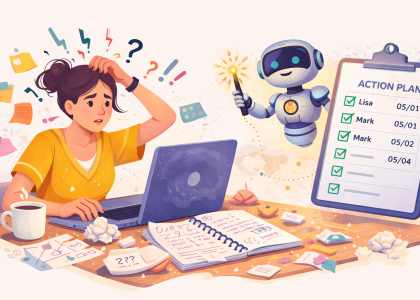
Many work problems aren’t really about workload.
They’re about decisions.
Most of the time, teams don’t get stuck because they lack ideas.
They get stuck because the decision is messy.
Too many variables, assumptions, “what if” scenarios.
That’s where a surprisingly simple AI trick can help.
The Problem With Decisions
When we think about a decision in our heads, we usually do it in a linear way.
Option A feels safer.
Option B feels more exciting.
Option C might be risky.
But our brains rarely visualize the full structure of consequences.
And without structure, decisions feel heavier than they actually are.
The Simple AI Trick
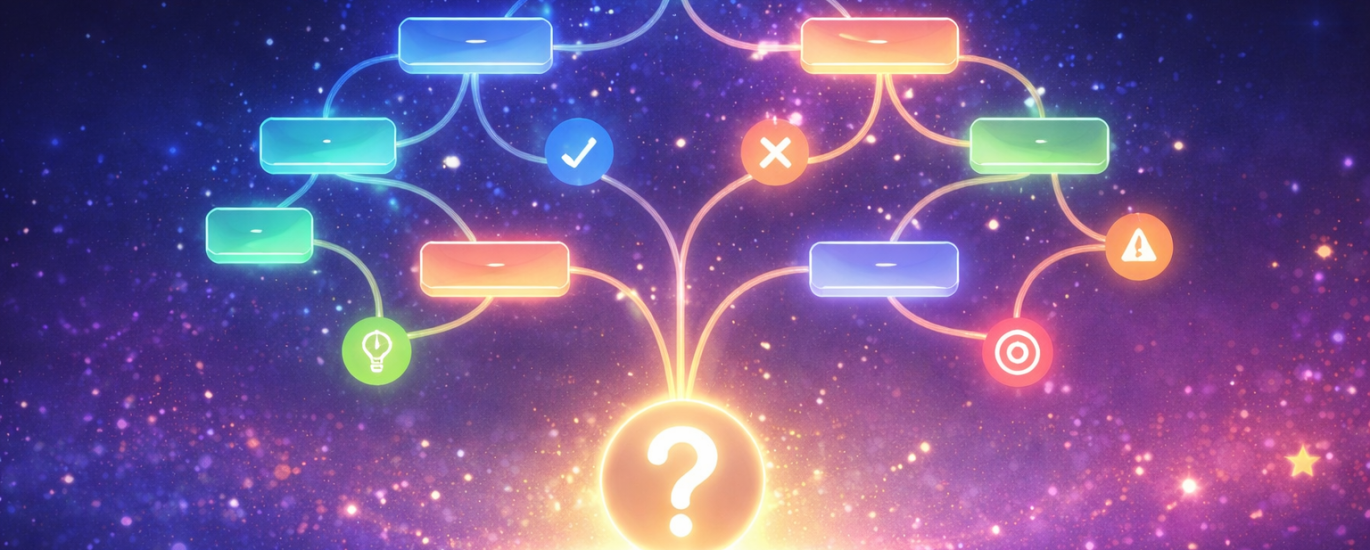
Instead of asking AI what you should do, ask it to map the decision.
Try a prompt like this:
“Create a decision tree for this situation. List the main options, possible outcomes, risks, and second-order effects.”
Suddenly, the problem stops being a vague dilemma.
It becomes a visual structure.
You can see the paths.
Example
Let’s say the decision is:
Should we launch a new product feature now or wait two months?
AI might structure the decision like this:
Option A — Launch Now
Pros:
- faster feedback from users
- early market visibility
Risks:
- unfinished UX
- possible negative first impressions
Possible outcomes:
- fast iteration
- early traction
Option B — Wait Two Months
Pros:
- more polished product
- fewer bugs
Risks:
- competitor launches first
- loss of momentum
Possible outcomes:
- stronger first impression
- delayed learning
Suddenly, the decision becomes clearer.
You’re no longer guessing.
You’re evaluating paths.
AI Tools That Work Well for This
You can use several AI tools to generate decision trees and structured analysis.
ChatGPT
One of the easiest tools for this. It handles structured prompts well and can break down decisions into options, risks, and outcomes.
Claude
Very good at long reasoning and structured analysis, especially when decisions involve multiple variables.
Perplexity AI
Useful when decisions require research and sources, because it can combine structured reasoning with real-world information.
Notion AI
Great if you want to turn a decision tree directly into tasks or a project plan.
Why This Works
Your brain tends to process decisions emotionally.
AI processes them structurally.
That difference matters.
Instead of feeling overwhelmed by possibilities, you see a map of outcomes.
And once you see the structure, decisions become easier.
The Bigger Insight
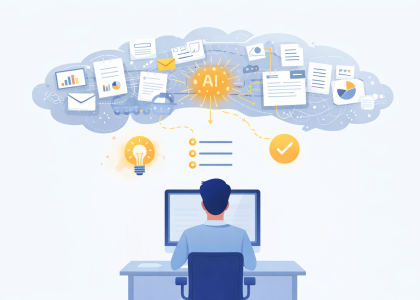
AI isn’t just a tool for writing or generating content.
It’s becoming a thinking assistant.
One that helps you:
- structure problems
- compare scenarios
- visualize consequences
And that’s where real efficiency appears.
Final Thought
Most decisions feel heavy because they’re unstructured.
Turn them into a tree.
One prompt.
Clear paths.
Much faster thinking.
That’s how you get 99% more efficiency.