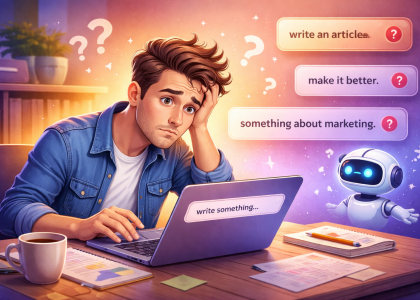

Everyone is asking the wrong question.
“Will AI take my job?”
The better question is:
Why was your job dependent on inefficient processes in the first place?
Because here’s the uncomfortable truth:
AI doesn’t eliminate humans.
It eliminates friction.
And friction has been hiding inside our workflows for years.
The Real Thing AI Is Attacking
Not creativity.
Not strategy.
Not decision-making.
AI is attacking:
- Copy-paste tasks
- Manual formatting
- Repetitive research
- Context-switching between 12 tabs
- Rewriting the same email 5 times
- Extracting insights from scattered data
In other words: badly designed processes we normalized.
We built workflows around human limitation.
Now we’re shocked that software can optimize them.
What Actually Gets Replaced
Let’s be honest. When companies say “AI replaced this role,” what usually happened is:
A 7-step manual workflow became a 2-step automated one.
That’s not human replacement.
That’s process compression.
And if your value was trapped inside those 5 unnecessary steps, the system was the problem — not the technology.
The Hidden Cost of Bad Processes
Before AI, inefficiency was invisible.
You could spend:
- 3 hours summarizing research
- 2 hours editing subtitles
- 1 hour restructuring notes
- 45 minutes cleaning formatting
And it felt “normal.”
Multiply that by weeks, teams, departments.
That’s not work.
That’s drag.
AI exposes drag.
And once you see it, you can’t unsee it.
The Shift: From Doing to Designing
The professionals who thrive in the AI era aren’t the fastest executors.
They are:
- Workflow designers
- System thinkers
- Prompt engineers (whether they call themselves that or not)
- People who know how to define a problem clearly
Because AI doesn’t solve vague thinking.
It amplifies clarity.
Garbage in → faster garbage out.
Clear thinking in → leveraged output.
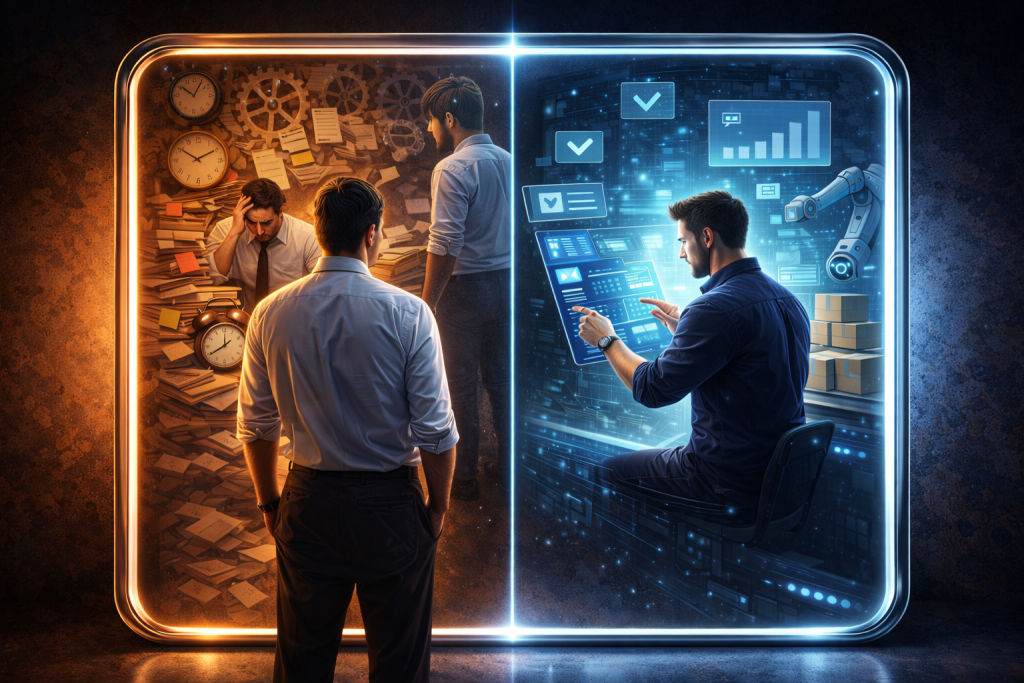
AI Is a Process Mirror
Here’s what’s really happening:
AI acts like a mirror.
It reflects:
- Where you are inefficient
- Where you rely on repetition instead of thinking
- Where your systems are outdated
And that reflection feels threatening.
But it’s not destruction.
It’s redesign.
The People Who “Lose” to AI
It’s rarely about intelligence.
It’s about rigidity.
If your identity is tied to:
- “I do this manually.”
- “This is how we’ve always done it.”
- “Automation kills quality.”
Then yes, AI feels like an enemy.
But if your identity is tied to:
- “I solve problems.”
- “I optimize systems.”
- “I design better workflows.”
Then AI becomes leverage.
The Real Competitive Advantage
The winners won’t be:
- The people who avoid AI
- The people who blindly automate everything
The winners will be:
People who know what not to automate.
Because strategy, taste, ethics, and final judgment still require humans.
AI compresses execution.
Humans define direction.
The New Job Description
The future professional isn’t:
“Task executor.”
It’s:
System architect. Decision maker. Process optimizer.
If AI can replace you entirely, the issue wasn’t AI.
It was that your role was built on inefficiency.
Final Thought
AI isn’t replacing people.
It’s replacing:
- Unnecessary steps
- Invisible friction
- Legacy workflows
- Comfort zones
And that’s not a threat.
That’s evolution.
The real question isn’t:
“Will AI take my job?”
It’s: