
The other night I opened a news website to check one thing. Just one. Within seconds I was clicking away cookie banners, closing pop-ups, muting an autoplay video, and trying to read around flashing ads that seemed designed to test my willpower. Then came the paywall. Somewhere in that mess, I forgot what I came for in the first place.
That’s when it hit me.
We don’t hate news. We hate the way we’re forced to consume it.
Scrolling endlessly. Dodging ads. Clicking headlines that overpromise and underdeliver. Opening five tabs just to understand one story. It’s chaotic, inefficient, and strangely exhausting.
And here’s the wild part: AI is finally good enough to fix this.
So I started thinking about a side-hustle idea that feels small enough to prototype in a few weeks but big enough to turn into a real company. Not another newsletter. Not another aggregator. Something different. Something I’d actually use every day.
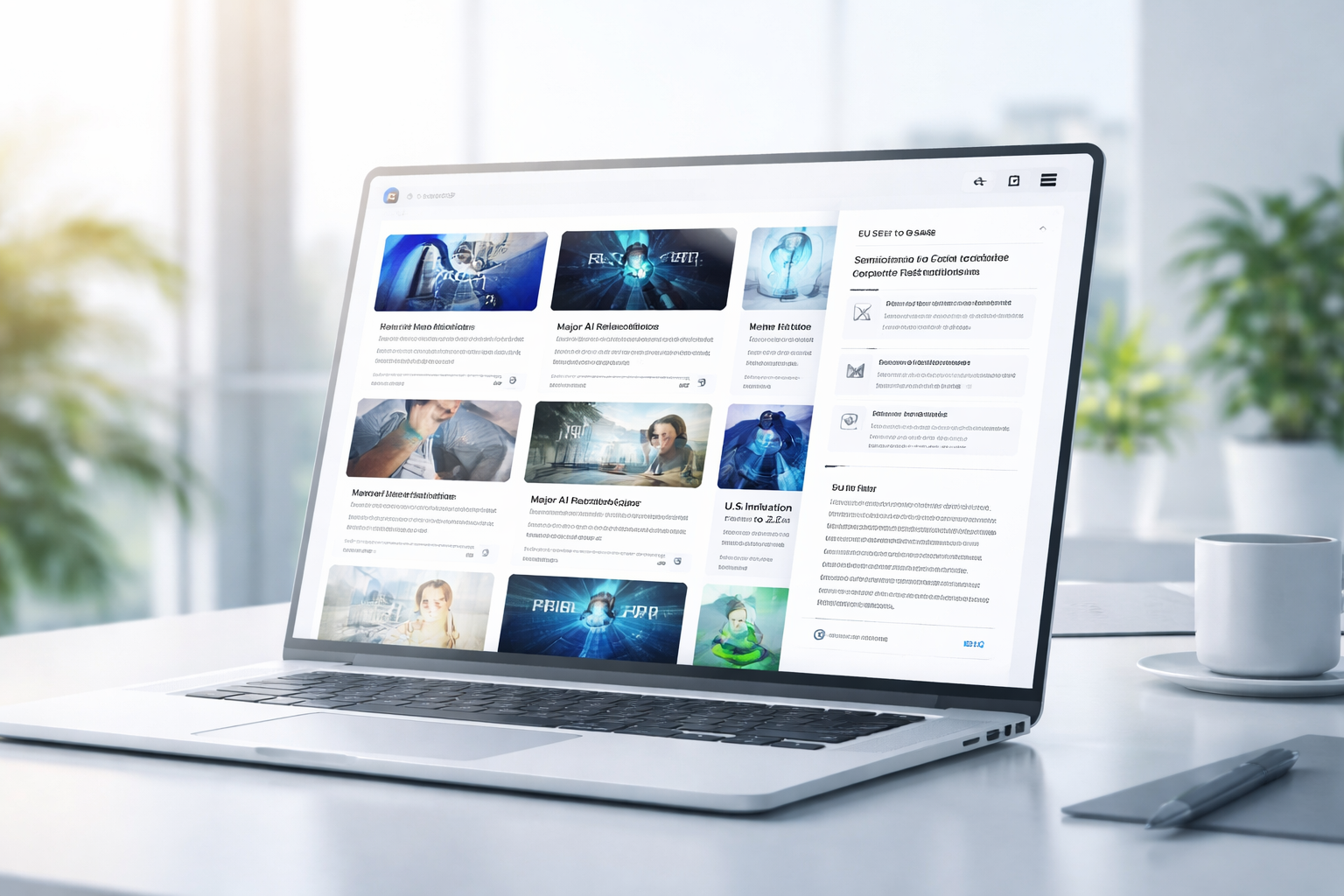
Imagine opening a clean web app. No ads. No clutter. No infinite feed. Just a dashboard that refreshes every hour with the most relevant stories based on your preferences. Each story shows a sharp AI-generated headline, a single sentence explaining what happened, a clean image, and a few topic tags. You scan. You understand. You move on.
When something catches your attention, you click it. Instead of being thrown into a publisher’s maze of banners and distractions, you get a clean AI-generated brief: what happened, why it matters, and what to watch next. Structured. Clear. Efficient.
But here’s where it becomes interesting.
Inside that article, certain phrases are subtly highlighted. If the story mentions the European Central Bank, you can click it. If it references semiconductor export restrictions, you can click that too. When you do, a side panel opens instantly with a short explanation of what it is and why it matters in this specific context. If you want to go deeper, you expand further. If you don’t, you ignore it and keep reading.
You don’t scroll down into a rabbit hole.
You branch sideways.
You move through the news the way you move through Wikipedia — intentionally, directionally, choosing your own path. Instead of being pulled by an algorithm into the next emotionally charged headline, you navigate based on curiosity.
That’s why I think of it as “directional news.”
Now here’s the part that makes it more than just a cool demo. If a thousand people click the same story, the system doesn’t regenerate the full brief a thousand times. It generates it once and caches it. The same goes for those expandable explanations. The intelligence is shared. Personalization happens in the ranking and ordering, not in reinventing the story for every single user.
That’s how it becomes scalable instead of expensive.
Origin of the idea
Since I was a kid, I used to play this strange little game: I’d open Wikipedia and start reading an article, but with one rule — the moment I hit the first hyperlink about something I didn’t understand or wanted to learn more about, I had to click it. Then I’d do the same thing on that page. And again. And again.
I could start with fish biology and, a few clicks later, find myself deep in the world of Chinese philosophers — completely lost, but learning the entire time.
This isn’t about replacing journalism. It’s about reorganizing how we interface with it.
News sites optimize for time on site. This would optimize for clarity per minute.
There’s a massive psychological difference between endless feed consumption and intentional exploration. One feels addictive. The other feels empowering.
And the best part is that this doesn’t require a giant team or venture capital to start. You could begin with a handful of trusted RSS feeds, an hourly update job, an AI API for summarization, a simple database, and a clean frontend.
Build it around one niche vertical first — AI and startups, European regulation, energy markets, biotech, even regional news. Own one vertical deeply before expanding.
If users open a story and then branch into two, three, four contextual expansions, you’ll know you’ve changed behavior. I’d obsess over one metric: how often people choose to explore sideways instead of leaving. That’s the signal.
Zoom out and the vision gets bigger. It could become a daily executive briefing tool, a team intelligence dashboard, even a voice-based morning rundown in your chosen tone. Friendly. Analytical. Straight-to-business. The same underlying content, adapted to how you think.
The real opportunity here isn’t “better news.”
It’s better navigation.
Right now, information is infinite but clarity is scarce. We are drowning in updates but starving for structured understanding. The interface hasn’t evolved — it’s still scroll, click, scroll, click, scroll.
What if instead, it was explore?
I don’t want more content. I want control over how I move through it. I want to open something, understand the world in five focused minutes, and dive deeper only where my curiosity pulls me.
If someone builds that well, I’d switch immediately.
And whenever an idea solves your own daily frustration that cleanly, there’s a decent chance it’s not just a side hustle.
It’s the beginning of something bigger.
Now pull out Replit or Lovable and start building.