

“AI Isn’t That Good.”
Or Maybe… You Didn’t Ask It Very Well.
Let’s start with a mildly uncomfortable truth.
Most of the time when someone says,
“AI isn’t that good,”
what they actually mean is:
“I typed something vague and got something vague back.”
AI isn’t magic. It’s not a mind reader. It doesn’t “get what you meant.” It gets what you wrote.
And prompting? It’s not some secret hacker ritual. It’s not about memorizing mystical formulas.
It’s just structured thinking.
Why Vague Prompts Lead to Average Results
AI is very literal. If you give it a blurry question, it gives you a blurry answer.
Weak prompt:
Write something about marketing.
That’s not a prompt. That’s a shrug.
What kind of marketing? For who? What tone? What format? How long? Beginner or advanced?
The AI doesn’t know — so it guesses. And guesses are average by definition.
Vague in → generic out.
How to Be Specific (Without Writing a Novel)
Specific doesn’t mean complicated. It means intentional.
Better prompt:
Write a short LinkedIn post about email marketing for small business owners.
Now we’re getting somewhere.
You’ve told the AI:
- the platform (LinkedIn)
- the topic (email marketing)
- the audience (small business owners)
- the length (short post)
Already, the output will feel sharper.
You didn’t add complexity.
You added clarity.
The Power of Context
AI works better when it understands the situation around the task.
Imagine this:
Weak prompt:
Write a product description.
Okay. For what? Who’s buying it? Luxury? Budget? Fun? Technical?
Now add context:
Better prompt:
Write a product description for a minimalist productivity app aimed at overwhelmed freelancers. Keep it calm and reassuring.
Now the AI knows:
- the product type
- the audience’s emotional state
- the tone
Context turns content into communication.
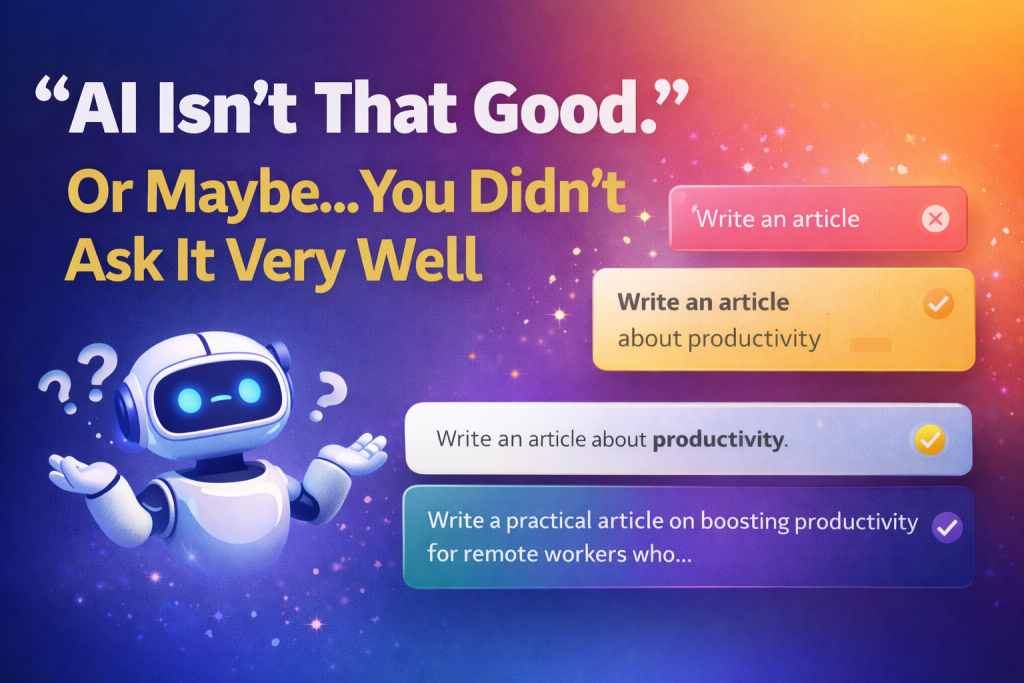
Weak vs Better vs Great (Side-by-Side)
Let’s do a simple example.
Weak:
Write an article about productivity.
Better:
Write a practical article about productivity for remote workers.
Great:
Write a practical, slightly witty article about productivity for remote workers who feel constantly distracted. Include 3 actionable tips and end with a short reflective takeaway.
See the shift?
You’re not making it harder.
You’re making your thinking visible.
Iteration Is Normal (Not Failure)
Here’s another thing people get wrong.
They expect perfection on the first try.
AI doesn’t work like a vending machine. It works like a conversation.
Try.
Adjust.
Refine.
Add detail.
Remove fluff.
Clarify tone.
Prompting is less about “getting it right” and more about steering.
If this sparked your curiosity, there’s a great YouTube video about ChatGPT 5.2 prompting that dives even deeper into the mechanics.
Prompting Isn’t a Trick. It’s Thinking.
When you write a good prompt, you’re doing something subtle:
You’re clarifying:
- what you actually want
- who it’s for
- how it should feel
- what outcome you expect
That’s not AI wizardry.
That’s clear thinking.
And here’s the quiet twist:
Learning to prompt well doesn’t just improve AI output.
It improves how you explain ideas.
How you brief designers.
How you delegate tasks.
How you structure your own thoughts.
Final Thought
AI isn’t “smart” in the way we imagine.
It responds to structure.
If your question is fuzzy, your result will be fuzzy.
If your thinking is clear, your output usually follows.
So maybe prompting isn’t about mastering AI.
Maybe it’s about mastering clarity.
And that’s a skill worth having — with or without the robots.
Lorem ipsum dolor sit amet, consectetur adipiscing elit. Ut elit tellus, luctus nec ullamcorper mattis, pulvinar dapibus leo.